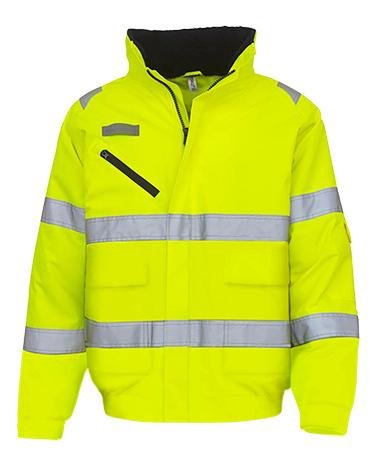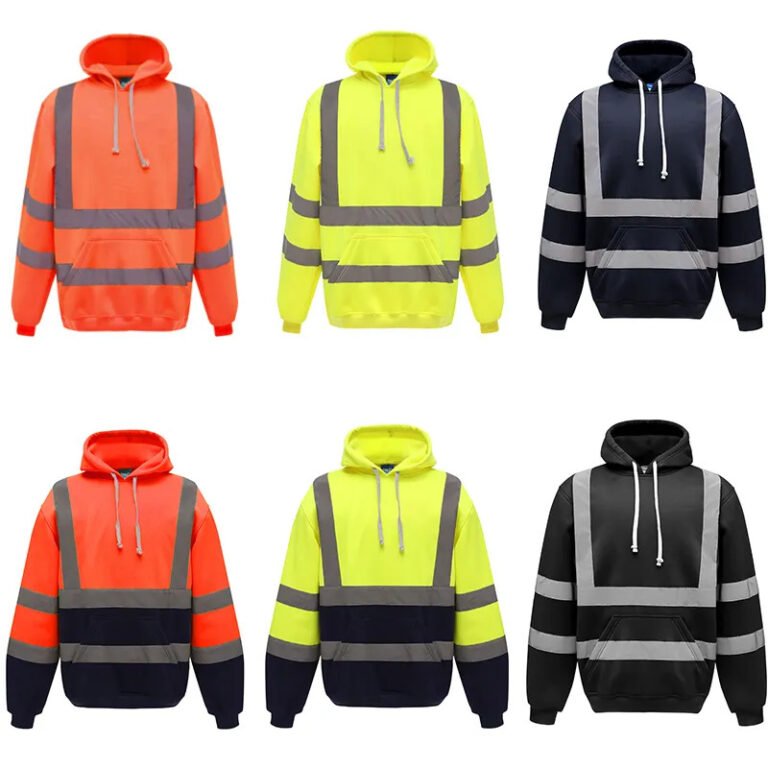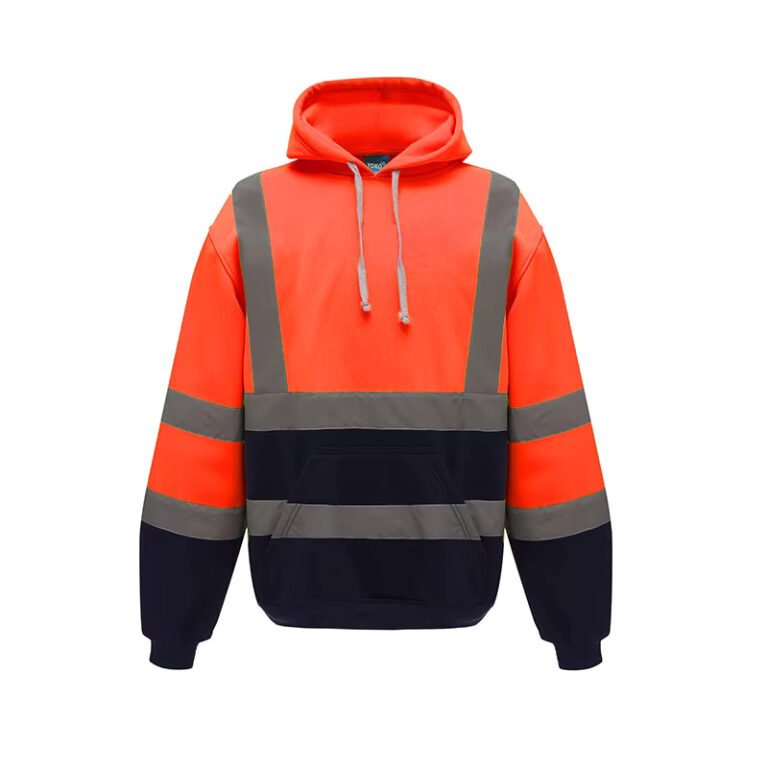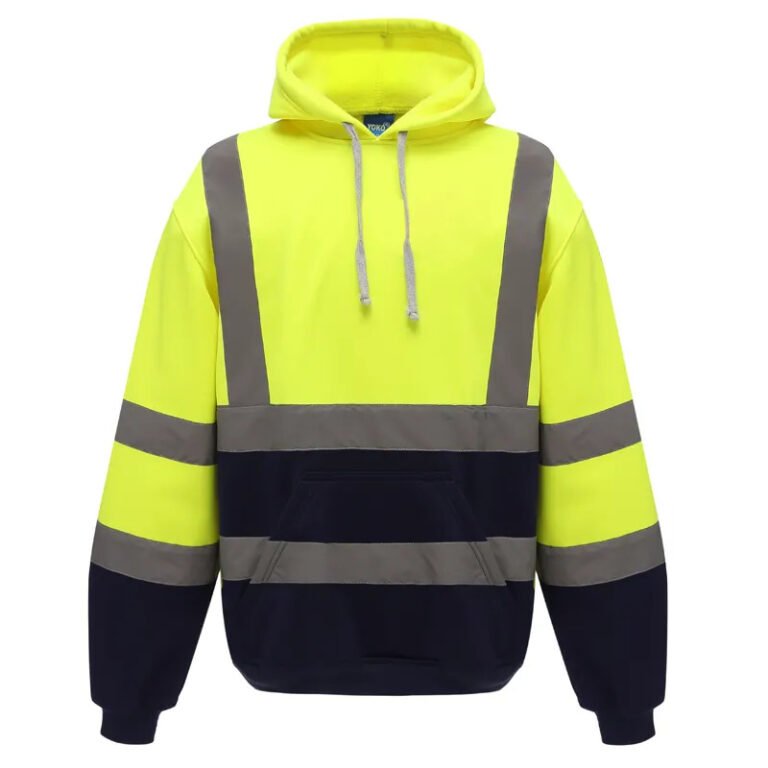
Polyester vs. Cotton vs. Blends: What’s the Best Material for Hi Vis Hoodies?
A manufacturer’s expert comparison of materials for safety hoodies that meet compliance standards while delivering comfort and durability.
The Quick Answer (For Busy Decision-Makers)
For ANSI/ISEA 107 and EN ISO 20471 compliant hi-vis hoodies, a polyester-cotton blend (typically 65% polyester / 35% cotton) is the industry-standard best choice. This composition delivers critical fluorescent colorfastness through its polyester outer face while providing cotton-rich interior brushed fleece for warmth and comfort. Pure 100% cotton outer shells cannot maintain compliance-grade fluorescent intensity after repeated industrial laundering, making them unsuitable for safety applications. Meanwhile, 100% polyester excels in hot, humid climates requiring maximum moisture-wicking but may sacrifice some comfort in cooler environments. The blend offers the optimal compromise for the majority of North American and European work conditions.
Why Material Selection Matters for Safety Compliance
Choosing the right material for hi-vis hoodies isn’t just about comfort—it’s about meeting strict safety standards that could save lives. The fluorescent color of your hoodie must maintain its visibility-enhancing properties through hundreds of wash cycles, extreme weather conditions, and daily wear and tear.
⚠️ Compliance Reality Check
Both ANSI/ISEA 107 (North America) and EN ISO 20471 (Europe) standards mandate specific minimum levels of fluorescent color brightness and retroreflective performance. If your hoodie’s material cannot hold fluorescent dye through industrial laundering, it will fail compliance testing—and more critically, fail to protect your workers.
The three key performance factors determined by material choice are:
- Colorfastness: Ability to retain fluorescent yellow/orange intensity after 50+ wash cycles
- Durability: Resistance to abrasion, tears, and pilling in harsh work conditions
- Comfort & Functionality: Moisture management, breathability, and thermal regulation
Material-by-Material Deep Dive
🔷 100% Polyester: The Performance Champion
✅ Advantages
- • Exceptional colorfastness: Fluorescent dyes bond permanently to synthetic fibers
- • Superior moisture-wicking: Pulls sweat away from skin efficiently
- • Quick-dry properties: Ideal for humid/wet conditions
- • Lightweight: Reduces worker fatigue
- • Extreme durability: Highly resistant to abrasion and tearing
❌ Disadvantages
- • Less breathable: Can feel clammy in moderate climates
- • Static build-up: Uncomfortable in dry environments
- • Less natural comfort: Some workers find synthetic feel less comfortable against skin
- • Lower insulation: Not as warm in cold weather without heavy fleece lining
Best for: Hot, humid climates (Middle East, Southeast Asia), outdoor construction in summer, workers who perspire heavily, high-activity roles.
🔶 100% Cotton: The Comfort Contender (With Serious Limitations)
✅ Advantages
- • Superior comfort: Soft, natural feel against skin
- • Excellent breathability: Natural fiber allows air circulation
- • Hypoallergenic: Less likely to cause skin irritation
- • Biodegradable: Environmentally friendlier end-of-life
❌ Critical Disadvantages
- • ⚠️ POOR COLORFASTNESS: Fluorescent dyes fade rapidly with washing
- • ⚠️ FAILS COMPLIANCE: Cannot maintain ANSI/EN ISO brightness standards
- • Absorbs and retains moisture: Becomes heavy and cold when wet
- • Slow to dry: Worker discomfort in rain/snow
- • Shrinkage issues: Sizing inconsistency after laundering
- • Lower abrasion resistance: Wears out faster
⚠️ Critical Warning: 100% cotton outer shells are NOT recommended for compliant hi-vis workwear. They may be acceptable only for interior linings where colorfastness is not a compliance factor. Always verify with fluorescent material standards before specifying cotton.
🏆 Polyester-Cotton Blend (65/35 or 60/40): The Industry Standard Winner
This engineered blend combines the best of both worlds through strategic fabric construction: polyester-rich outer face for compliance and durability, with a cotton-rich inner fleece for comfort and warmth.
✅ Why It’s the Professional’s Choice
- • Compliance-grade colorfastness: Polyester face holds fluorescent dyes
- • Enhanced comfort: Cotton interior feels soft and warm
- • Balanced moisture management: Better than pure cotton, more comfortable than pure poly
- • Reduced shrinkage: More dimensional stability than 100% cotton
- • Optimal warmth-to-weight ratio: Perfect for variable climates
- • Cost-effective: Balances performance with price point
⚖️ Minor Trade-offs
- • Slightly slower drying than 100% polyester (but much faster than cotton)
- • Moderate static in very dry conditions (less than pure poly)
- • Requires proper laundering to maintain optimal performance
Ideal for: Construction sites, roadwork crews, warehouses, manufacturing facilities, logistics operations—essentially 80% of industrial safety applications in North America and Europe.
| Performance Factor | 100% Polyester | 100% Cotton | 65/35 Blend |
|---|---|---|---|
| Fluorescent Colorfastness | Excellent ★★★★★ | Poor ★ | Excellent ★★★★★ |
| ANSI/EN ISO Compliance | ✅ Yes | ❌ No | ✅ Yes |
| Comfort (Next-to-Skin) | Good ★★★ | Excellent ★★★★★ | Very Good ★★★★ |
| Moisture-Wicking | Excellent ★★★★★ | Poor ★ | Very Good ★★★★ |
| Durability (Abrasion) | Excellent ★★★★★ | Fair ★★ | Very Good ★★★★ |
| Drying Speed | Fast ★★★★★ | Slow ★ | Moderate ★★★★ |
| Warmth/Insulation | Moderate ★★★ | Good ★★★★ | Very Good ★★★★ |
| Best Climate | Hot & Humid | ❌ Not Suitable | Cool to Moderate |
💡 Expert Insight from the Field
As someone who talks to safety managers and procurement officers from different continents every single day, the question of “which material is best” isn’t just about a spec sheet—it’s about people and performance. My clients aren’t just buying hoodies; they’re investing in their team’s safety and comfort.
Here’s my field-tested reality check: 100% cotton is a non-starter for the outer shell. It simply cannot hold the fluorescent color to meet EN ISO 20471 or ANSI/ISEA 107 standards after a few washes, and it becomes dangerously heavy and cold when wet. We never recommend it for compliance.
The real debate is between 100% polyester and a poly-cotton blend. For hot, humid climates like the Middle East or construction projects in Southeast Asia, clients prioritize moisture-wicking and quick-dry properties, so a lightweight 100% polyester fleece is often the winner.
However, for the vast majority of our clients in Europe and North America, the poly-cotton blend is the undisputed champion. It offers the perfect compromise: the outer face is polyester, providing the crucial colorfastness and durability, while the inner-brushed fleece is rich in cotton, providing the warmth and next-to-skin comfort that workers demand for a long shift in cooler, variable weather.
Ultimately, my advice is always this: Prioritize compliance and durability with polyester on the outside, but never underestimate the value of comfort on the inside. A comfortable worker is a safer, more productive worker. Learn more about fabric weight specifications to further optimize your selection.
— Senior Technical Consultant, VizGlo Safety Technology
How to Choose: Decision Matrix by Work Environment
🏗️ Construction Sites
Recommended Material: 65/35 Poly-Cotton Blend
Why: Variable weather, moderate activity levels, need for all-day comfort. Blend provides warmth in early morning, breathability by afternoon, and maintains compliance through harsh conditions and frequent laundering.
🚧 Highway & Roadwork Crews
Recommended Material: 60/40 or 65/35 Poly-Cotton Blend
Why: High visibility is life-critical. Polyester outer ensures fluorescent color never fades. Cotton interior provides comfort during extended outdoor exposure. Also consider crewneck options for summer months.
📦 Warehouse & Logistics
Recommended Material: 65/35 Poly-Cotton Blend or 100% Polyester
Why: Climate-controlled environments with moderate activity. Blend works well for most. In high-activity picking roles or non-climate-controlled facilities in summer, opt for 100% polyester for superior moisture management.
☀️ Hot & Humid Climates (Middle East, Southeast Asia, South US)
Recommended Material: 100% Polyester (Lightweight, 200-280 GSM)
Why: Maximum moisture-wicking and quick-dry properties prevent heat stress. Workers stay cooler and drier. Fluorescent color retention is still excellent. Learn about GSM specifications for hot weather gear.
❄️ Cold Weather Operations (Northern US, Canada, Northern Europe)
Recommended Material: 65/35 Poly-Cotton Blend (Heavy Weight, 350-400 GSM)
Why: Thicker fleece provides essential insulation. Cotton content maximizes warmth. Polyester outer maintains color compliance and blocks wind. Often worn as a mid-layer under hi-vis jackets.
Beyond Material: Other Critical Factors
🎨 Customization & Branding
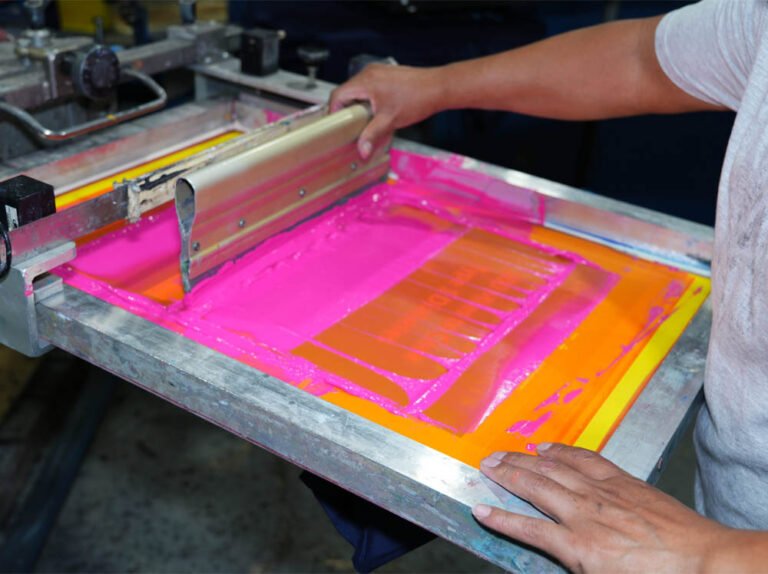
Material choice affects how your company logo will appear. Polyester-rich fabrics work better with heat-transfer vinyl and screen printing, while blends excel with embroidery.
📏 Fabric Weight (GSM)
Don’t overlook GSM (grams per square meter). A 280 GSM hoodie feels completely different from a 350 GSM version, even in the same material. Match weight to climate and activity level.
🧵 Reflective Tape Quality
Your material is only as good as its reflective components. Ensure ANSI-certified reflective tape is sewn (not just heat-sealed) for maximum durability.
🏢 Team Uniformity
Consider matching team workwear for professional appearance. Poly-cotton blends offer better color consistency across large bulk orders.
🎨 Quick Note on Black & Orange Hi-Vis Hoodies
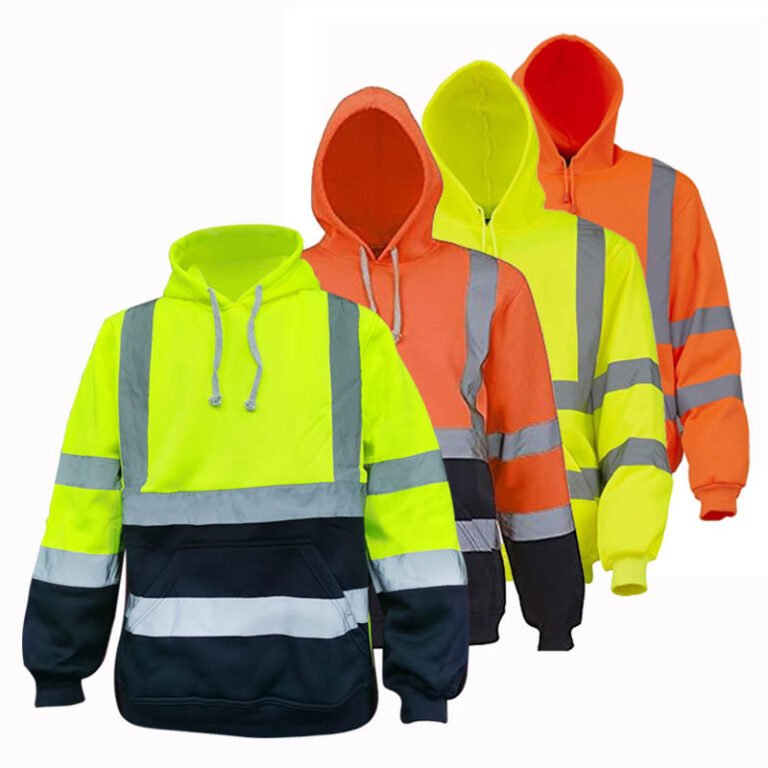
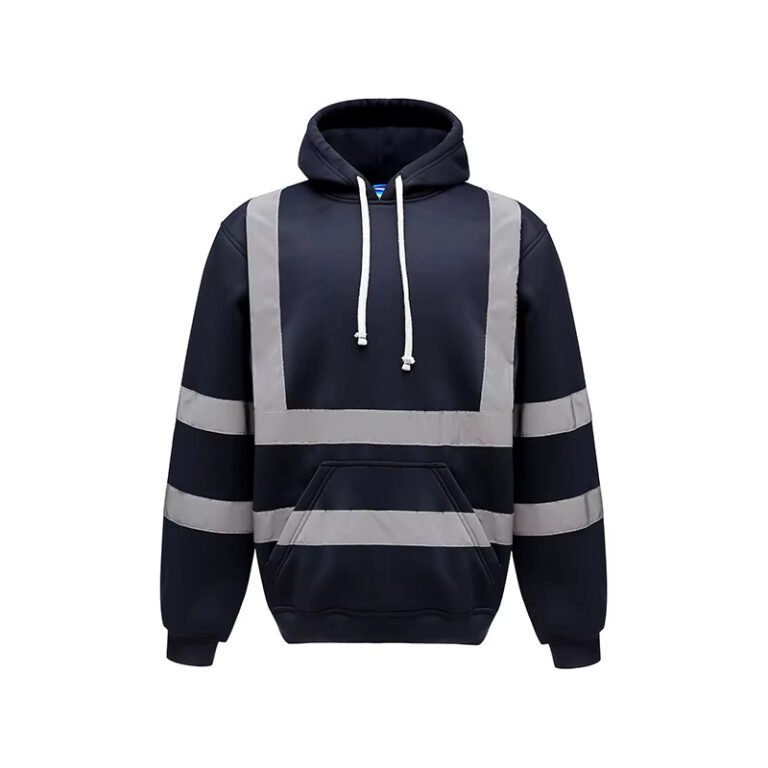
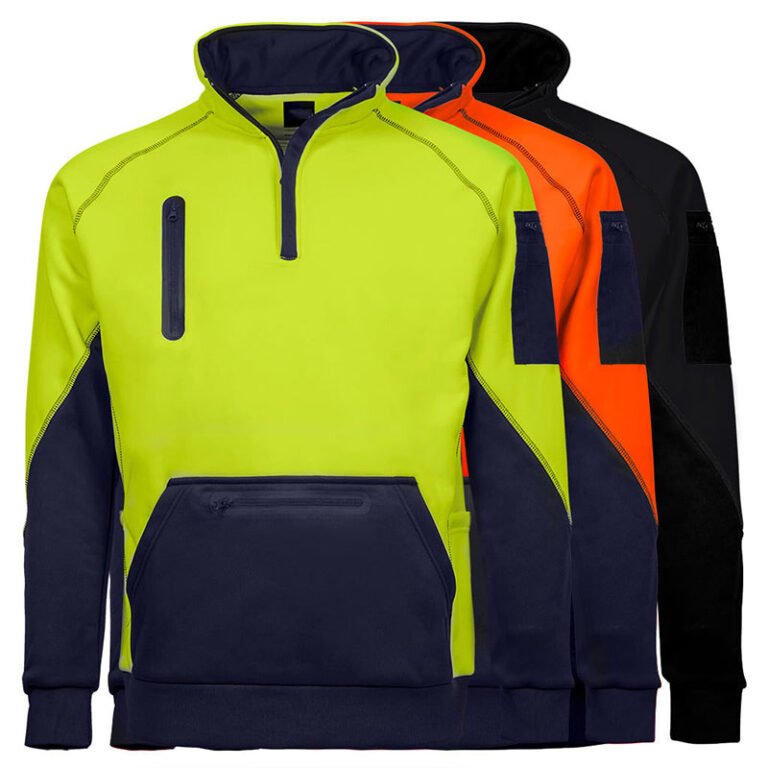
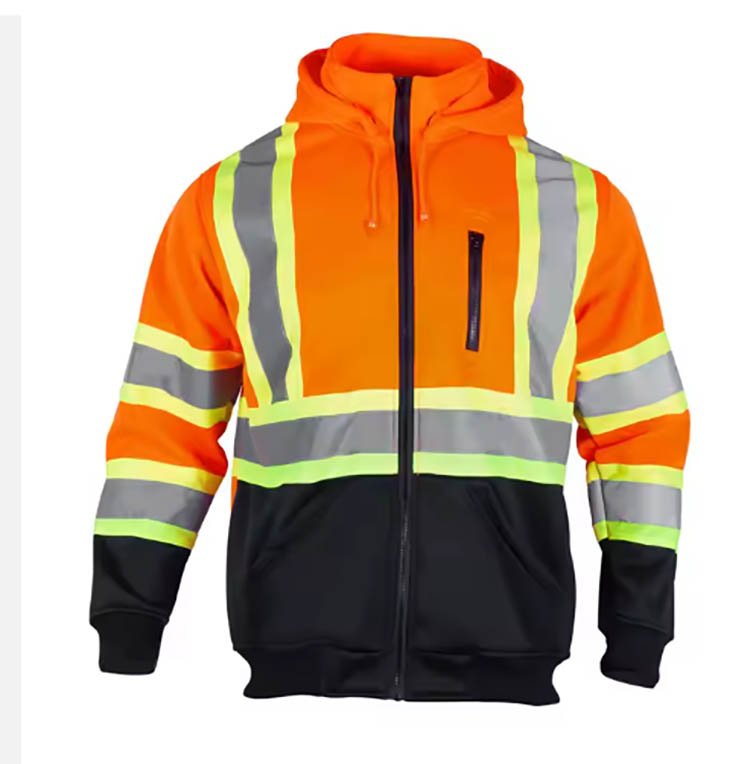
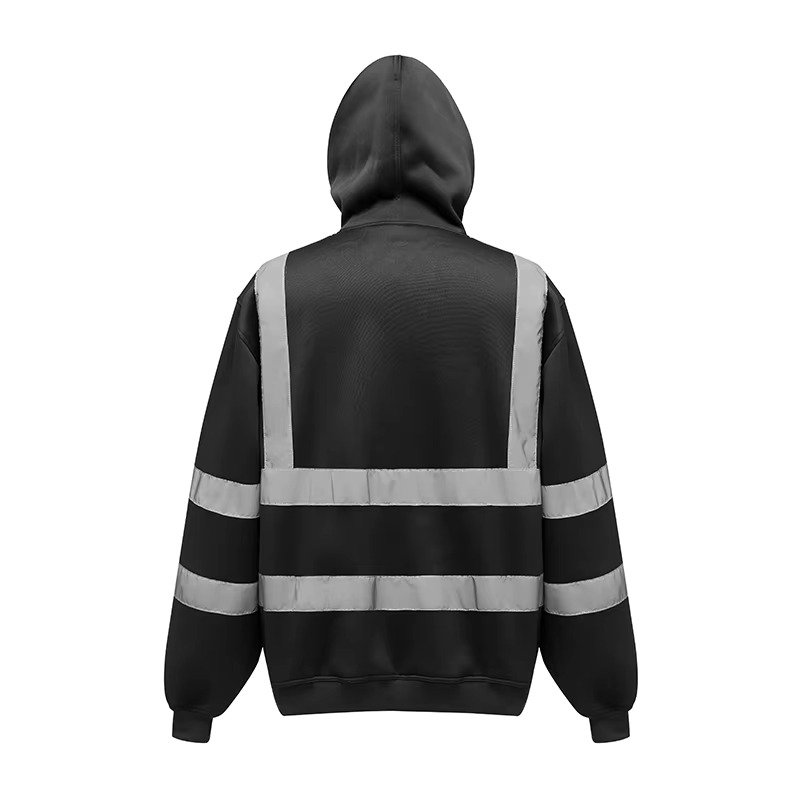
Modern black and orange combination hoodies are increasingly popular, but compliance is nuanced. Only the fluorescent orange panels count toward ANSI/ISEA 107 requirements—the black sections do not. Material choice for the orange panels remains critical; always specify polyester or poly-cotton blend for these areas.
Ready to Source Compliant Hi-Vis Hoodies?
Work directly with VizGlo Safety’s engineering team to select the optimal material composition for your specific application. We offer small to large bulk orders with full customization and guaranteed ANSI/EN ISO compliance.
🚀 Get Your Custom Quote NowOr explore our full range: Browse Hi-Vis Hoodies & Sweatshirts
Frequently Asked Questions
Can I use 100% cotton hi-vis hoodies for ANSI/ISEA 107 compliance?
No, not for the outer shell. 100% cotton cannot maintain the required fluorescent color brightness after industrial laundering. The fluorescent dyes fade too rapidly, causing the garment to fail photometric testing (minimum 0.2 square meters of fluorescent background material with specific brightness values). Cotton may be acceptable for interior linings where color retention is not a compliance factor, but the visible outer shell must be polyester or a polyester-dominant blend. Always specify materials that have been pre-tested for ANSI/ISEA 107 colorfastness.
What’s the difference between 65/35 and 60/40 poly-cotton blends?
The difference is subtle but meaningful. 65/35 (65% polyester / 35% cotton) offers slightly better colorfastness and durability, making it the safer choice for maximum compliance longevity. 60/40 provides a marginally softer hand feel and slightly better moisture absorption due to higher cotton content. In practice, both perform excellently for hi-vis hoodies in most climates. When in doubt, specify 65/35 for maximum compliance confidence, especially if you’re ordering for large bulk orders with long service life expectations.
How many washes should a compliant hi-vis hoodie withstand?
ANSI/ISEA 107 and EN ISO 20471 both require that garments maintain minimum fluorescent color brightness and retroreflective performance for a minimum of 50 home wash cycles or 25 industrial wash cycles. However, professional-grade hoodies made from quality polyester or poly-cotton blends routinely exceed this, often maintaining compliance for 100+ washes when properly cared for. Key factors include using mild detergents, avoiding chlorine bleach, and following proper care instructions. Always request wash cycle test data from your manufacturer.
Is 100% polyester uncomfortable for all-day wear?
Not necessarily—it depends on the climate and the worker’s activity level. Modern moisture-wicking polyester fleece with brushed interior surfaces has come a long way in comfort. In hot, humid environments or high-activity roles, 100% polyester is often more comfortable than cotton because it keeps workers drier. However, in cooler, variable climates typical of North America and Europe, many workers do prefer the softer, more natural feel of poly-cotton blends for long shifts. It’s also worth considering why teams are switching to performance fabrics. The best approach? Offer your crew a choice and gather feedback.
Can I source hi-vis hoodies directly from China with custom materials?
Yes, absolutely. Working directly with a Chinese manufacturer like VizGlo Safety offers significant advantages for material customization. You can specify exact fabric compositions (e.g., 65/35 blend outer with 80/20 cotton-rich interior fleece), customize GSM weights, select specialized performance treatments (anti-static, water-repellent, etc.), and even develop proprietary fabric blends for your brand—all at compelling price points for orders from 500 to 50,000+ pieces. The key is partnering with an experienced, certified manufacturer who understands North American and European compliance requirements and can provide pre-production samples for your approval.
What material works best for printing or embroidering company logos?
Both polyester and poly-cotton blends work well for customization, but each has sweet spots. Polyester is ideal for heat-transfer vinyl and screen printing due to its smooth surface and heat tolerance. Poly-cotton blends are the gold standard for embroidery because the cotton content provides better needle penetration and thread hold. For maximum brand impact, many companies use a combination: embroidered logos on the chest (premium look) with screen-printed safety messaging on the back. Always discuss your branding requirements with your manufacturer before finalizing material selection.
Related Resources
The Bottom Line
When it comes to hi-vis hoodies, material selection is not just a comfort decision—it’s a compliance and safety imperative. 100% cotton fails on colorfastness and should never be used for outer shells. 100% polyester excels in hot, humid conditions but may sacrifice some comfort in cooler climates. For the vast majority of applications in North America and Europe, a 65/35 or 60/40 polyester-cotton blend delivers the optimal balance: unwavering compliance, exceptional durability, and the all-day comfort your workers deserve.
Whether you’re outfitting a construction crew, upgrading your warehouse team’s PPE, or sourcing bulk orders for a large project, always prioritize materials that have been proven through rigorous wash testing and carry proper certifications. Your workers’ visibility—and their lives—depend on it.