How to Find a Reliable Reflective Logo Manufacturer in China
Navigate the sourcing landscape with confidence: A practical checklist for identifying manufacturers who prioritize safety standards, not just price tags.
The Real Question: Price or Protection?
Finding a reliable reflective logo manufacturer in China isn’t about hunting for the lowest cost per unit on Alibaba—it’s about identifying a technical partner who understands that reflective logos must survive certification testing and real-world conditions. A truly trustworthy manufacturer will ask you critical questions about your base fabric, washing requirements, and target certifications (such as EN ISO 20471 or ANSI/ISEA 107), rather than simply offering a per-piece quote. The adhesive chemistry, reflective glass bead retention, and weeding precision are just as critical as the base reflective film itself. When you prioritize the right manufacturer over the lowest bidder, you protect your entire product line from costly rejections, reshipments, and damaged brand reputation.
Why Quality & Consistency Matter More Than Price
In over a decade of navigating the reflective materials sourcing landscape, the single biggest mistake I see is clients chasing the lowest per-unit cost. They compare five quotes on Alibaba, select the one with the best price, and six months later, they’re facing a commercial disaster: a full container of branded jackets rejected because the reflective logos peeled off after the required 25-wash durability test.
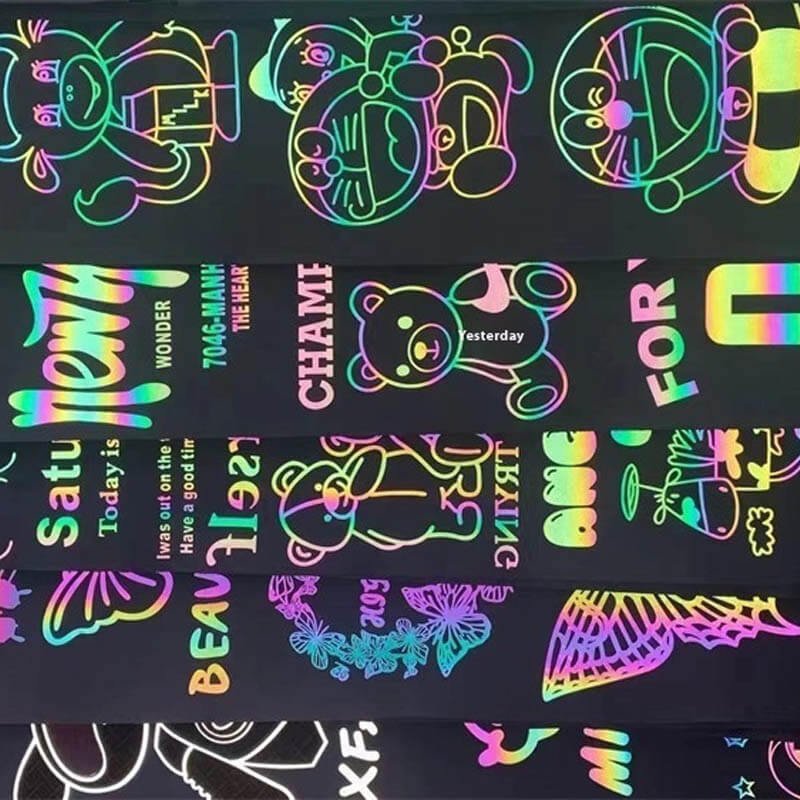
This isn’t a theoretical concern. The issue is that reflective logo manufacturing is not commoditized. The adhesive formulation, the glass bead particle size, the base film thickness, and the application pressure all interact in ways that aren’t visible in a single sample. A factory burning corners on adhesive chemistry might deliver stunning samples that fail certification testing.
⚠️ The Hidden Cost of “Budget” Manufacturers
A rejected container can cost you $5,000–$25,000 in lost goods, reshipping, expedited production fees, and lost revenue. Saving $0.10 per logo to end up with a $50,000 problem is poor business arithmetic.
Your manufacturer should be a technical partner, not just a transaction. They need to understand your market’s requirements, your end-user environment, and the regulatory landscape. This is where true reliability is built.
The 5-Point Supplier Vetting Checklist
When evaluating a reflective logo manufacturer, move beyond surface-level assessments. Use this checklist to dig deep into their operational and technical capabilities.
Certifications & Compliance Documentation
Ask for proof of ISO 9001, BSCI (or equivalent ethical compliance), and specific product certifications relevant to your market. In Europe, request evidence of EN ISO 20471 compliance. In North America, ask about ANSI/ISEA 107. For Australia/NZ markets, inquire about AS/NZS 1906.4.
Pro tip: Don’t accept verbal assurances. Request third-party test reports from accredited labs. A legitimate manufacturer will have these on file.
Production Equipment & Capacity
Ask about their equipment: digital cutting machines for precision weeding, automated heat-application systems for consistent pressure/temperature, and quality control stations. Visit the factory if possible—or request recent factory tour videos. The presence of modern, well-maintained equipment is a strong indicator.
Red flag: If they’re hand-cutting logos or using inconsistent heat presses, production variance will be significant.
Portfolio & Case Studies
Request references from established brands they supply. Ask specifically about long-term clients—repeat business is a trust signal. Request samples or examples of logos applied to different fabric types (PU-coated polyester, stretchy softshell, rigorous industrial fabrics). The manufacturer should have proof of performance across fabric varieties.
Verify: Independently contact 2–3 of their existing clients to ask about quality consistency and responsiveness.
Quality Control Process
Understand their QC workflow. Do they conduct incoming material inspection (IQC)? Process QC (PQC) during production? Final QC (FQC) before shipment? Ask about their acceptance rate—what percentage of logos pass the first time, and what are the failure modes? A manufacturer who transparently discusses rejection rates and corrective actions is building trust.
Key question: “Walk me through your quality protocol for a 1,000-unit order.”
Communication & Technical Expertise
Do they ask you smart questions about your application? A quality manufacturer will probe: “What’s your base substrate? Will there be post-printing? What’s the wash temperature and cycle? Are you targeting certification?” If they simply send you a quote without these questions, you’re dealing with a transactional supplier, not a partner.
Indicator: A strong technical team responds to your inquiry within 24 hours with clarifying questions, not just a price list.
Red Flags to Watch Out For
🚨 Suspiciously Low Quotes
If a quote is 30%+ below the market average, there’s likely a quality or compliance shortcut being taken. Reflective material costs don’t vary that dramatically between legitimate suppliers.
🚨 Vague on Standards
If they can’t articulate the difference between EN 20471 Class 2 and Class 3, or don’t have data on wash durability per ISO 6330, walk away. They don’t understand your market.
🚨 No Transparency on Materials
A reputable supplier will name the specific adhesive type, glass bead grade, and base film they use. If they say “it’s proprietary” and won’t discuss composition, you can’t assess performance or troubleshoot failures.
🚨 Reluctance on Samples
A quality manufacturer will eagerly provide samples applied to your fabric with documentation. If they’re evasive or push for full orders without proving capabilities, reconsider.
🚨 Poor Communication History
In your initial dialogue, if responses are delayed, vague, or come from multiple uncoordinated people, the production team will likely be the same. Consistency starts in the sales process.
🚨 No Real References
If they claim to supply major international brands but can’t provide verifiable contact information or references, it’s likely embellishment. Real clients leave digital footprints.
Critical Testing Standards to Ask About
Before placing an order, ensure your manufacturer explicitly understands and can produce to these core tests. These are the hurdles your product must clear in regulated markets.
Retro-Reflectivity Retention After Washing
Critical test per ISO 6330. Ask: “What is your logo’s retro-reflectivity (in cd/m²/lx) after 25 industrial wash cycles at 40°C?” Certification requires logos to retain minimum brightness. Poor adhesives will allow the reflective film to peel and curl at fabric edges during washing.
💡 Ask for the specific data: “Provide test reports showing retro-reflectivity values before and after ISO 6330 25-cycle wash test.”
Color Fastness & Dye Migration
For colored reflective logos applied to dyed garments, the dye can migrate into the adhesive, weakening the bond and causing discoloration. Your manufacturer should have data on color fastness to washing per ISO 105-C06 standards.
💡 Ask: “Do you have compatibility data between reflective film adhesive and common fabric dyes?”
Peel Strength & Adhesion Durability
A standard 90-degree peel test determines how easily the logo peels from fabric. Your manufacturer should guarantee minimum peel strength. Stretchy fabrics and soft-shell materials require different adhesive formulations.
💡 Ask: “What is the 90-degree peel strength in N/cm for logos applied to [your specific fabric]?”
Durability Against Industrial Laundering
If your garments are subject to professional industrial washing (common for workwear), logos must survive high-temperature cycles and mechanical agitation. Ask if the manufacturer has tested to ISO 14403 or similar industrial laundry standards.
💡 Ask: “Can you provide test data for logos after 25, 50, and 100 industrial wash cycles at 75°C?”
💡 Pro Insight: A manufacturer who can’t immediately provide or reference these test reports is not ISO-aligned. Don’t assume “we’ve done this for years” equates to having the documentation.
Building a Long-Term Partnership vs. One-Off Deals
The most valuable reflective logo manufacturers are those who see your business as a partnership, not a transaction. Here’s how to cultivate that relationship and ensure ongoing consistency:
Hallmarks of a True Partner
- ✓ Proactive Communication: They reach out if market standards shift, or recommend process improvements based on industry trends.
- ✓ Continuous Sample Testing: They run periodic internal tests to ensure your logo designs remain compliant and performant across production runs.
- ✓ Dedicated Account Management: You have a consistent point of contact who knows your product, your volume needs, and your compliance requirements.
- ✓ Transparent Problem-Solving: If an issue arises (e.g., a batch shows edge lifting), they immediately conduct root-cause analysis and provide corrective action, not just replacement parts.
- ✓ Growth Investment: As your volumes grow, they invest in dedicated tooling, equipment optimization, and R&D to maintain or improve quality.

Setting Success Criteria in Your Contract
When bringing on a reflective logo manufacturer, establish clear expectations in writing:
- → Minimum durability thresholds: Logo must retain X% retro-reflectivity after 25 industrial washes at 40°C (or your specific requirement).
- → Defect tolerance: Maximum 2% defective units per 1,000-unit batch (adjust based on your QC risk tolerance).
- → Sample approval cycle: Samples must match production ±5% in brightness, adhesion, and color.
- → Documentation delivery: All test reports and compliance certificates delivered with each shipment.
The difference between a commodity supplier and a strategic partner is responsiveness under pressure. When you have an issue—say, a retailer reports logos fading after 5 washes instead of 25—a true partner investigates immediately. They’re invested in your success because your brand’s reputation affects their reputation in the market.
Understanding Reflective Logo Technology
Beyond vetting suppliers, it’s essential to understand the technical foundation of quality reflective logos and the various application methods. Our comprehensive guide on reflective material solutions covers the science behind retro-reflectivity, different film types (3M Diamond Grade vs. standard micro-prismatic), and how adhesive compatibility varies across fabric substrates. Whether you’re sourcing for construction, mining, railway, or logistics applications, understanding these fundamentals will empower you to ask better questions of manufacturers and ensure your supply chain is bulletproof.
Explore our complete guide to reflective logos →
Frequently Asked Questions
What’s the difference between reflective logo films (3M vs. generic)? +
Premium films like 3M Diamond Grade use advanced micro-prismatic beads that deliver higher retro-reflectivity (often 500+ cd/m²/lx) and better durability across industrial washes. Generic Chinese films may use lower-grade glass beads and weaker adhesive formulations, resulting in lower initial brightness (300–400 cd/m²/lx) and faster degradation. For safety-critical applications (road work, railways, mining), premium is justified. For general corporate branding, quality generic options (from vetted suppliers) can work if durability metrics are proven.
How long does a typical sample-to-production cycle take? +
A reliable manufacturer should deliver a sample within 5–10 working days (assuming your artwork is finalized). After you approve the sample, allow 2–4 weeks for production, depending on order volume. Rush orders incur premiums. Always build in a 2-week buffer in your supply chain planning to avoid stockouts.
Can I negotiate on price after placing an order? +
Typically, no—manufacturing quotes are locked once you place the order to ensure cost certainty and quality lock-in. However, bulk discounts (for 50,000+ units) or long-term partnership pricing (for 6–12 month commitments) can be negotiated before production begins. Transparent negotiation up front builds trust far better than asking for last-minute cuts.
What should I do if logos fail certification testing? +
Immediately notify the manufacturer with test data and photos. A quality partner will conduct root-cause analysis: Was it an adhesive issue, an application temperature variance, or incompatibility with your fabric dye? They should provide a corrective action plan and replace defective units at no charge. Document everything in writing. If they avoid responsibility or blame your fabric, it’s a sign of an unreliable partner.
Is there a way to verify certifications independently? +
Yes. If a manufacturer claims ISO 9001 certification, you can verify it through UKAS (UK Accreditation Service) or equivalent national bodies. For product certifications (like EN ISO 20471), ask for the test report accreditation number and verify the testing lab’s credentials. Most reputable labs publish their accreditation status online.
Ready to Source Reliable Reflective Logos?
Let VizGlo Safety guide you through the sourcing process. Our technical team has 15+ years of experience in reflective material manufacturing, quality assurance, and compliance. We’ll help you navigate the China sourcing landscape with confidence.
Schedule Your Free ConsultationWhy VizGlo Safety is Your Ideal Partner
Finding a reliable manufacturer is only half the equation. You also need to understand what differentiates quality- from cost-driven production. At VizGlo Safety, we manufacture reflective logos as a core component of our broader reflective material ecosystem. This means every logo we produce is tested against the same rigorous standards as our high-visibility apparel—and backed by our ISO 9001 certifications and compliance credentials.
Unlike transactional suppliers who view logos as a commodity line item, we treat them as critical safety components. Our in-house quality labs test every batch for retro-reflectivity, adhesion durability, and wash performance. We invest in our clients’ success, not just our order pipeline.
Explore our advanced reflective logo manufacturing capabilities →
Final Thoughts: Invest in Reliability, Not Just Price
Sourcing reflective logos from China doesn’t have to be a high-risk gamble. By systematically vetting manufacturers against technical standards, compliance certifications, and partnership capabilities, you shift the odds dramatically in your favor. The manufacturer who asks thoughtful questions about your fabric, your market, and your durability requirements is already signaling that they’re a different class of partner.
Yes, a reliable supplier may cost 15–25% more per unit than a bottom-feeder option. But when you calculate the cost of a rejected container, emergency reshipments, brand damage, and lost revenue, that premium becomes insurance. The conversation isn’t about “How cheap can I go?” It’s about “Who will protect my product and my reputation?”
Use the vetting checklist in this guide as your North Star. Demand transparency on testing and certifications. Ask for references and independently verify them. And remember: a quality manufacturer doesn’t just sell you logos—they become your technical partner in ensuring every garment that leaves your warehouse meets or exceeds certification standards.
“The cheapest deal today is often the most expensive learning experience tomorrow. Choose your reflective logo manufacturer not for the lowest bid, but for the clarity, competence, and commitment they bring to your supply chain.”