High Visibility Clothing Test Methods and Requirements: How Global Buyers De-Risk Their PPE Supply Chain
High visibility clothing test methods and requirements evaluate the optical, physical, and durability performance of fluorescent background fabrics and retroreflective materials to ensure life-saving worker visibility under all lighting conditions. Primary testing standards—such as EN ISO 20471 and ANSI/ISEA 107—mandate rigorous laboratory assessments for chromaticity coordinates, luminance factors (β), retroreflective coefficient (RA ≥ 330 cd/(lx·m²)), dimensional stability, tensile/bursting strength, and colorfastness against washing, perspiration, and mechanical abrasion across maximum certified care cycles.
1. Beyond the Certificate: Why Testing Precision Determines Sourcing Success
For procurement directors and product managers at industrial distributors, purchasing high-visibility garments is fundamentally an exercise in risk mitigation. A third-party test report dated two years ago does not safeguard a container of 20,000 safety vests from real-world failure. If background fabrics shift outside chromaticity limits or reflective bands delaminate after a handful of wash cycles, the results are catastrophic: rejected customs entries, failed customer audits, crippling product recalls, and severe liability exposure.
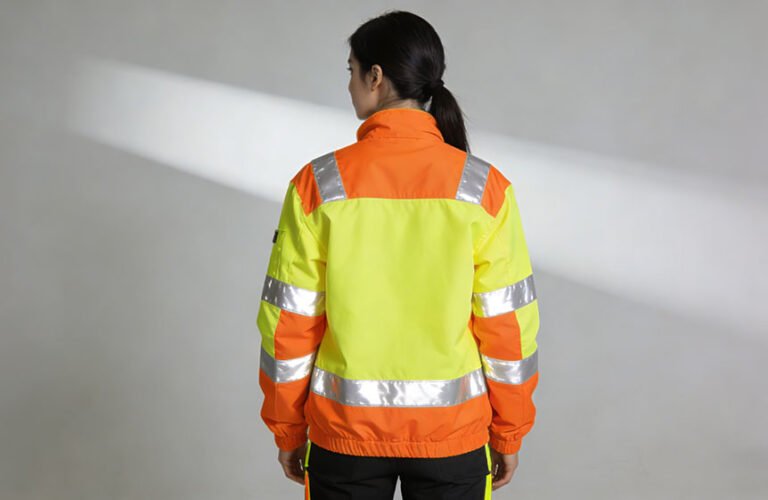
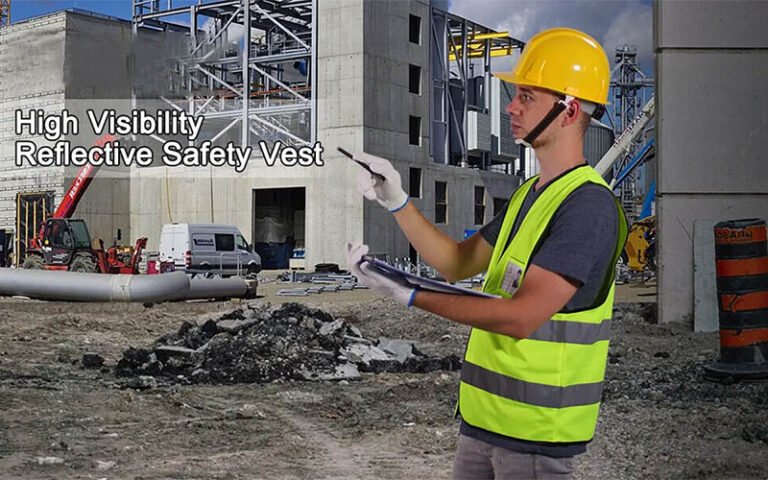
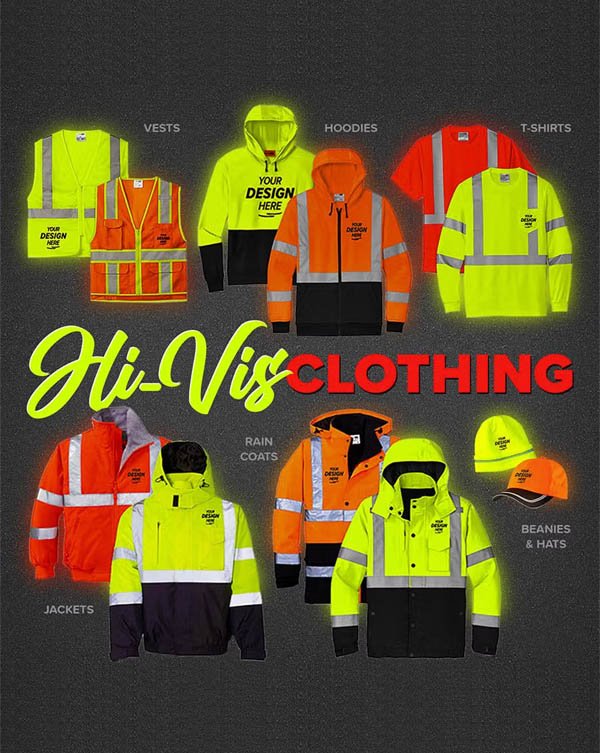
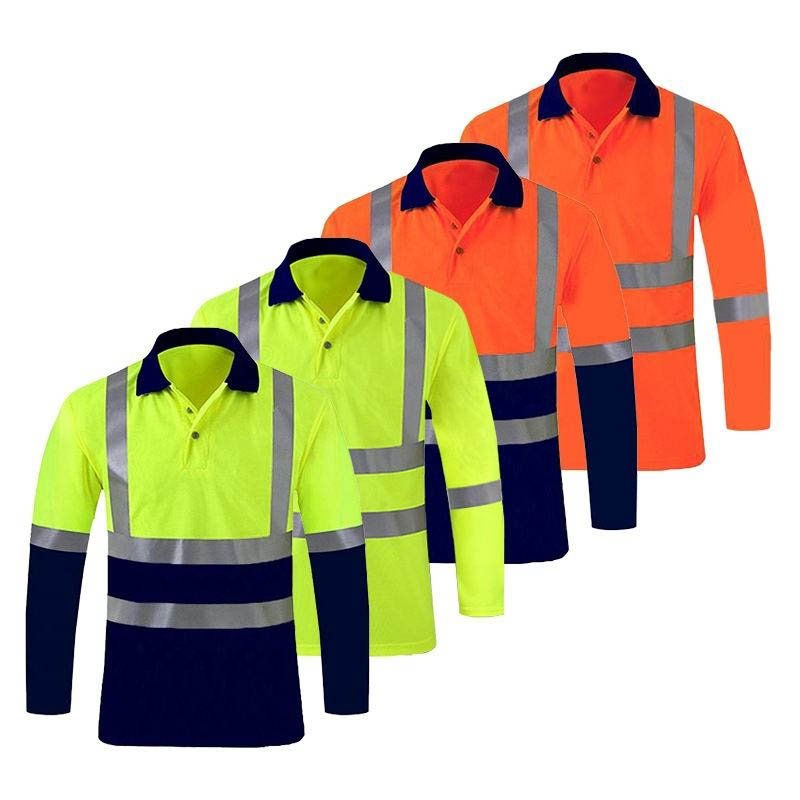
Professional high-visibility personal protective equipment (PPE) must perform flawlessly across varied microclimates—from rainstorms on highway paving projects to high-heat fabrication environments. Achieving compliance requires comprehensive knowledge of test parameters across raw material selection, manufacturing execution, and post-processing evaluation. Explore our comprehensive range of certified Hi Vis Clothing built specifically to satisfy strict international standards.

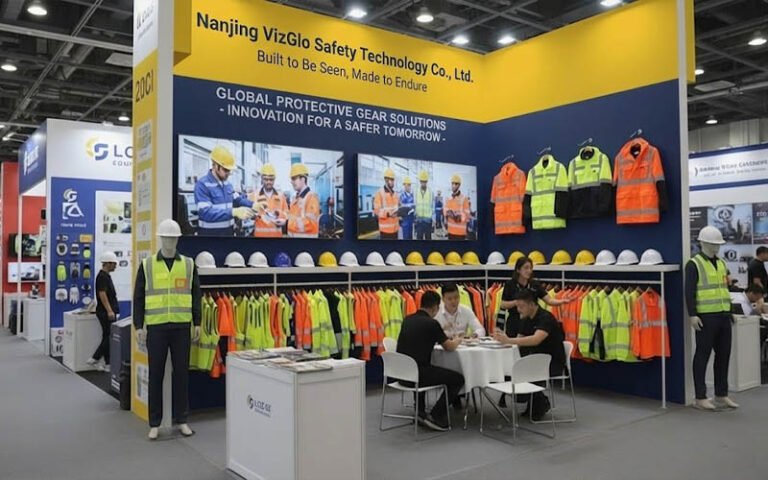
Rigorous batch-level physical and photometric testing guarantees international standard compliance.
2. Core Photometric & Optical Test Methods
The fundamental purpose of hi-vis apparel is visual contrast. Standards divide materials into two main optical categories: fluorescent background materials for daytime conspicuity, and retroreflective materials for low-light or nighttime illumination.
A. Fluorescent Background Material Tests
Fluorescent dyes absorb invisible ultraviolet radiation and re-emit it as visible light. The test protocol measures two key variables:
- Color Chromaticity Coordinates (x, y): Measured using a calibrated spectrophotometer under Standard Illuminant D65 with a 45/0 or 0/45 geometry. The resulting data points must sit completely within strict color tolerance boxes defined by ISO 20471 for Fluorescent Yellow, Orange-Red, or Red.
- Luminance Factor (β): Measures total perceived brightness. For fluorescent yellow, standard requirements dictate β ≥ 0.70, while orange-red requires β ≥ 0.40.
- Colorfastness to Light (Xenon Arc Test): Samples are exposed to artificial xenon arc lamp weatherometers per ASTM D1294 or ISO 105-B02 until blue wool reference standard 5 degrades to 4. After exposure, color and luminance must remain within compliant boundaries.
B. Retroreflective Performance & Mechanical Pre-conditioning
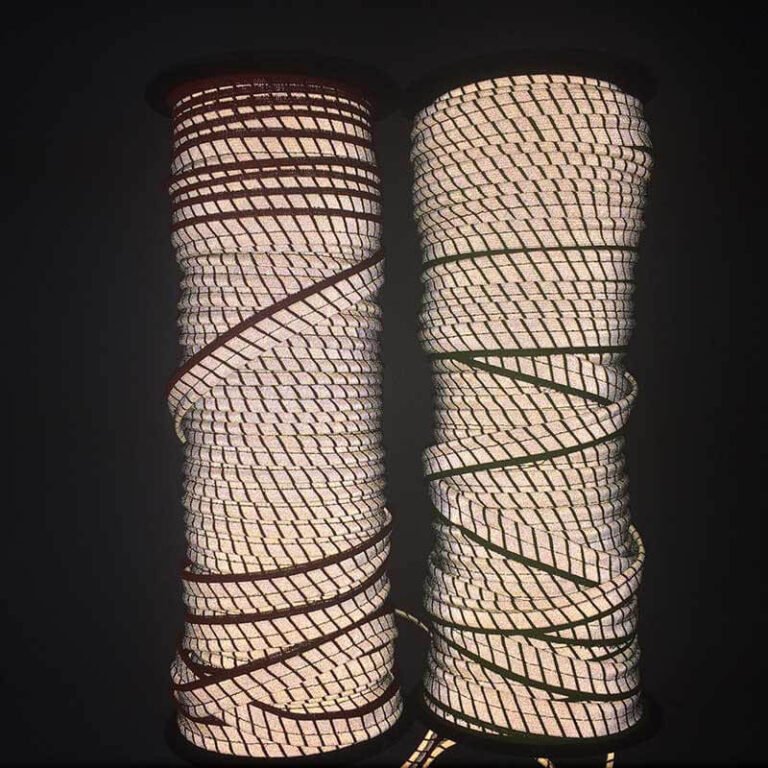
Retroreflective materials (such as micro-glass-bead tapes or micro-prismatic films) bounce light directly back toward the driver’s light source. The standard test calculates the coefficient of retroreflection (RA), measured in candelas per lux per square meter (cd/(lx·m²)).
Level 2 separate-performance tapes must achieve a minimum RA of 330 cd/(lx·m²) at an observation angle of 12′ (0.2°) and entrance angle of 5°. More importantly, standards mandate that retroreflective materials undergo severe mechanical pre-conditioning tests before retroreflection is re-assessed:
- Abrasion Resistance: Subjected to 5,000 cycles under Martindale abrasion (9 kPa load).
- Flexing Resistance: 7,500 continuous mechanical cycles per ISO 7854 Method A.
- Cold Fold Test: Folded and loaded under pressure after 4 hours at -20°C.
- Temperature Variation: Alternated between 50°C and -30°C extremes.
- Influence of Rainfall: Tested in continuous simulated downpour to ensure RA does not drop below 100 cd/(lx·m²).
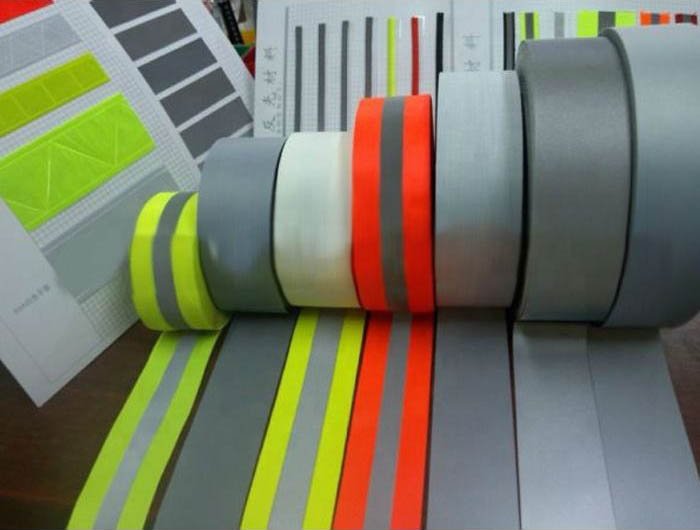
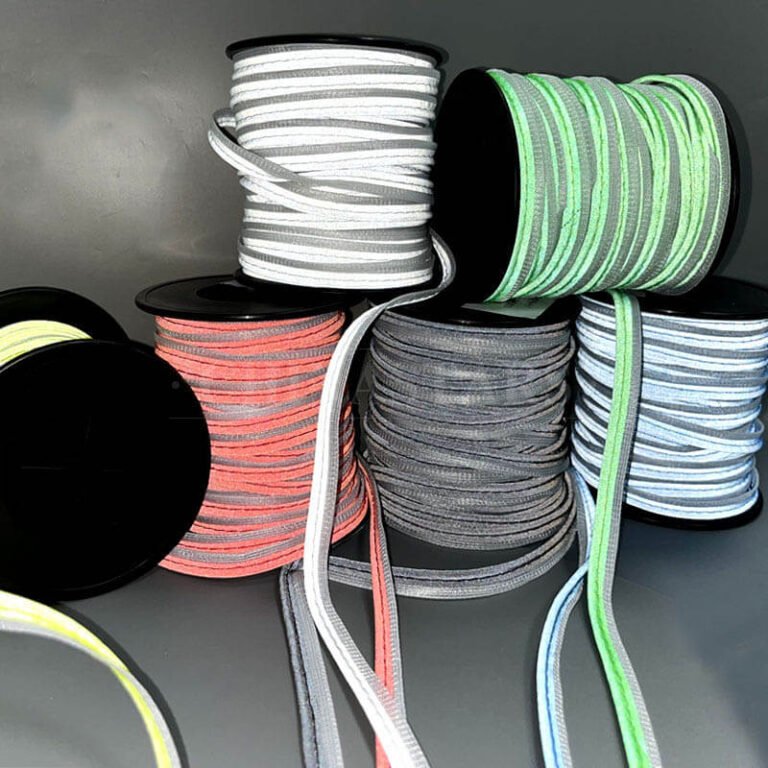
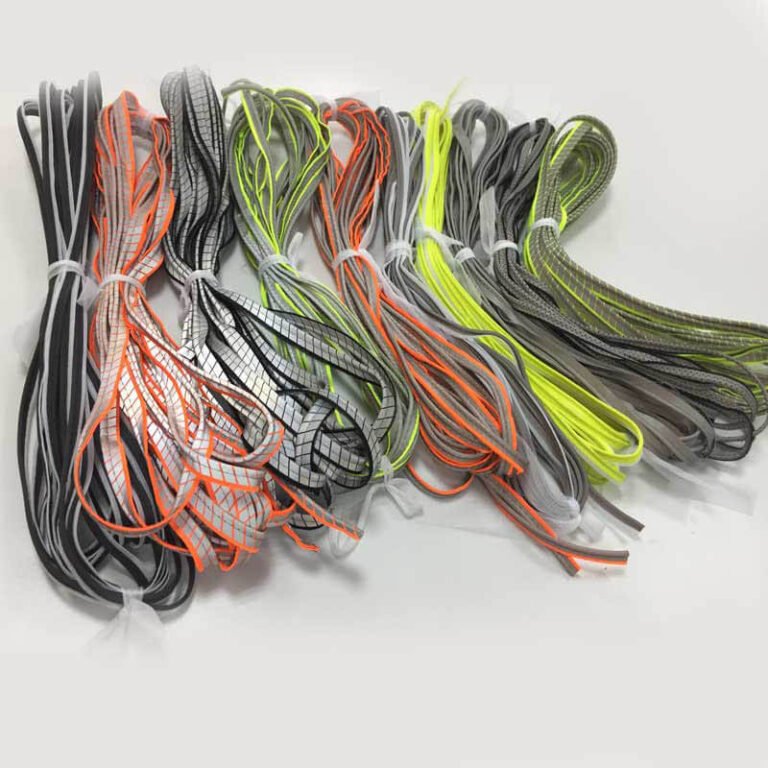
High-performance Reflective Tapes undergo intensive abrasion, wash-cycle, and luminance testing.
3. Physical Integrity and Garment Durability Requirements
Luminance and reflectivity mean nothing if the garment tears or shrinks off the wearer during industrial usage. Laboratory test protocols include comprehensive structural evaluations:
| Test Parameter | Test Method Standard | Standard Minimum Requirement |
|---|---|---|
| Tensile Strength (Woven) | ISO 13934-1 / ASTM D5034 | ≥ 100 N in warp and weft directions |
| Bursting Strength (Knitted) | ISO 13938-1 (Pneumatic) | ≥ 100 kPa (over 50 cm² area) |
| Dimensional Stability (Shrinkage) | ISO 5077 / ISO 6330 | Woven: ±3% max | Knitted: ±5% max |
| Colorfastness to Washing | ISO 105-C06 / AATCC 61 | Staining ≥ Grade 4; Color change ≥ Grade 4 |
| Colorfastness to Perspiration | ISO 105-E04 (Acid & Alkaline) | Color change ≥ Grade 4; Staining ≥ Grade 3-4 |
| Water Vapor Resistance (Breathability) | ISO 11092 (Sweating Guarded Hotplate) | Ret ≤ 5 m²·Pa/W for breathable weatherwear |
When selecting heavy-duty work garments, exploring specialized industrial construction is crucial. Review our complete line of robust Hi Vis Workwear engineered to withstand high industrial wash cycles and mechanical stress.
4. Global Matrix: EN ISO 20471 vs. ANSI/ISEA 107 vs. AS/NZS 1906.4
For brands operating across multinational jurisdictions, navigating regulatory divergences is a primary headache. While all standards share similar foundational principles, testing parameters vary significantly:
| Compliance Parameter | EN ISO 20471 (Europe/UK) | ANSI/ISEA 107 (North America) | AS/NZS 1906.4 & 4602.1 (ANZ) |
|---|---|---|---|
| Garment Classification | Class 1, Class 2, Class 3 | Type O, R, P (Class 1, 2, 3 + Supp E) | Class D, Class N, Class D/N |
| Standard Test Washes | 5 washes minimum (or manufacturer claimed max, e.g. 25-50x) | Tested after specified wash claim on label (typically 25x or 50x) | Up to 30 continuous industrial/domestic cycles |
| Design Requirements | 360-degree body encirclement with reflective tape mandatory | Allows discontinuous/split tape configurations under Type R | Mandates distinct “Hoop” or “H-pattern” configurations |
| Approved Fluorescent Colors | Yellow, Orange-Red, Red | Fluorescent Yellow-Green, Orange-Red, Red | Yellow, Orange, Red, Yellow/Orange Mix |
Understanding these nuances prevents major customs rejection issues. Detailed regulatory insights are publicly referenced by safety organizations like the International Safety Equipment Association (ISEA) and standard testing bureaus like SGS PPE Testing Services.
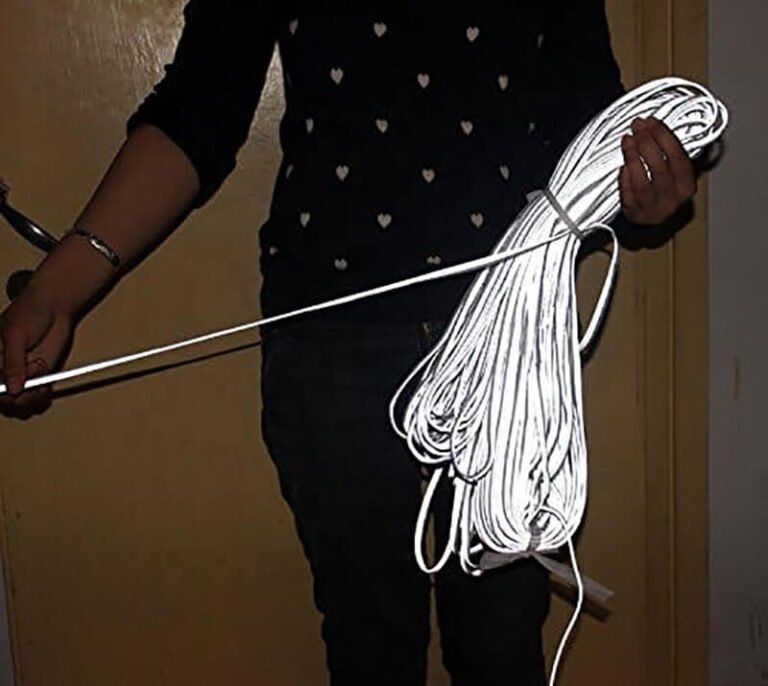
Quality testing equipment verifying colorfastness and retroreflection in high-spec laboratories.
5. How VizGlo Mitigates Supply Chain Risk: From IQC to FQC
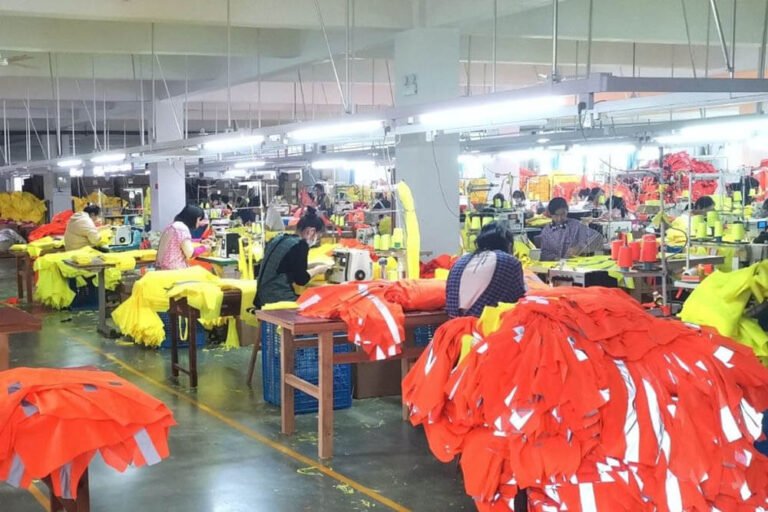
At Nanjing VizGlo Safety Technology Co., Ltd., we believe compliance is an active daily protocol rather than an archival PDF. Operating a vertically integrated ecosystem—from specialized reflective material synthesis to garment manufacturing—enables us to perform rigid in-house verification at every phase:
Every single fabric lot is checked with spectrophotometers for chromaticity (x,y) and luminance (β) coordinates before fabric cutting begins.
Continuous optical inspection and calibration of retroreflective material application, heat transfer bonding temperature, and seam stitch density.
Batch wash testing (5x, 25x, 50x cycles), seam strength verification, and portable retroreflectometer RA sign-off on finished production samples.
Looking to the future of PPE compliance in 2026 and beyond, requirements are rapidly expanding into ecological criteria, including chemical restrictions verified by OEKO-TEX Standard 100 and recycled GRS polyester tracing. Partnering with a manufacturer equipped for modern chemical and physical accountability keeps your enterprise ahead of evolving legislation. Learn how our Customization (OEM/ODM) capabilities protect your brand margin and safety reputation.
De-Risk Your Next Hi-Vis Order With VizGlo
Work with an OEM/ODM partner who operates dedicated in-house photometric and mechanical testing laboratories. Download test reports or request verified bulk samples today.
Request Compliant Lab Samples & Sourcing Consultation