How to Meet ANSI/ISEA 107 Standards with the Right Reflective Films for Clothing
A practical guide to selecting, applying, and maintaining compliant reflective films throughout your garment’s lifecycle
📋 Quick Navigation
- Understanding ANSI/ISEA 107 Standards
- Critical Performance Metrics: Beyond RA Values
- Types of Reflective Films and Their Compliance Implications
- Application Methods That Ensure Durability
- Testing and Verification Protocols
- Long-Term Compliance: Maintenance and Replacement Cycles
- Common Mistakes Manufacturers Make
- Frequently Asked Questions
Understanding ANSI/ISEA 107 Standards
ANSI/ISEA 107, formally known as “American National Standard for High-Visibility Safety Apparel and Accessories,” is the North American gold standard for workplace visibility. Unlike its European counterpart EN ISO 20471, ANSI 107 is performance-based rather than prescriptive, meaning it defines what your garment must achieve rather than exactly how to achieve it. This flexibility is both an opportunity and a minefield.
The standard specifies three performance classes (Class 1, 2, and 3), each requiring specific minimum retroreflective coefficients (RA values) and coverage areas. But here’s where most manufacturers stumble: they interpret “passes ANSI 107” to mean “passes the initial lab test.” That interpretation costs lives and reputations.

The real compliance battle happens post-manufacturing. ANSI 107 compliance must be maintained through the intended lifecycle of the garment—whether that’s 50 washes for a construction vest or 200 washes for utility company workwear. Your film choice determines whether you win or lose that battle.
Critical Performance Metrics: Beyond RA Values
Most buyers ask a single question about reflective films: “What’s the RA value?” They want Class 1 or Class 2 compliance, they see a datasheet showing RA ≥ 200 cd/lux/m², and they think they’re done. But a comprehensive compliance strategy requires understanding five interlocking performance dimensions:
1. Retroreflective Coefficient (RA)
This measures how much light the film returns toward its source. Class 1 requires RA ≥ 200 cd/lux/m²; Class 2 requires RA ≥ 350 cd/lux/m²; Class 3 requires RA ≥ 500 cd/lux/m². But remember: this is a minimum at initial testing. During your garment’s life cycle, this value will deteriorate.
2. Luminance Coefficient (RV)
This measures observed brightness at observation angles. It’s what the human eye perceives. A film might have high RA but poor RV, making it technically compliant but practically dim. When a truck driver sees your vest at 200 meters at night, they’re reacting to RV, not RA.
3. Wash Durability Index (WDI)
The critical metric most overlooked. WDI measures how many industrial washes a film can withstand before dropping below compliance thresholds. Premium segmented materials maintain 90%+ of initial RA after 25 washes; budget films drop to 60-70% after just 10 washes.

4. Wet Performance & Angular Dependence
ANSI 107 requires performance maintenance even under wet conditions. Some films lose 30-40% of brightness when wet—a critical liability if your workers operate in rain or humid environments.
5. Color Stability & UV Resistance
Fading isn’t just aesthetics—it impacts perceived visibility. A film that starts with high RA but fades to dull orange within 6 months creates a compliance risk that courts and regulators take very seriously.
Types of Reflective Films and Their Compliance Implications
Industrial reflective films come in three core categories, each with distinct compliance profiles:
Standard Micro-Prism Films (Budget Tier)
These are the most common and cheapest option. Tiny glass prisms refract light, creating the reflective effect. Initial RA values can reach 350-400 cd/lux/m², satisfying Class 1 requirements immediately.
The compliance trap: Most micro-prism films deteriorate rapidly under mechanical stress. After 8-12 industrial washes, RA drops below compliance thresholds. The adhesive layer between the prisms and backing fails; prisms delaminate; and suddenly your “compliant” garment violates regulations.
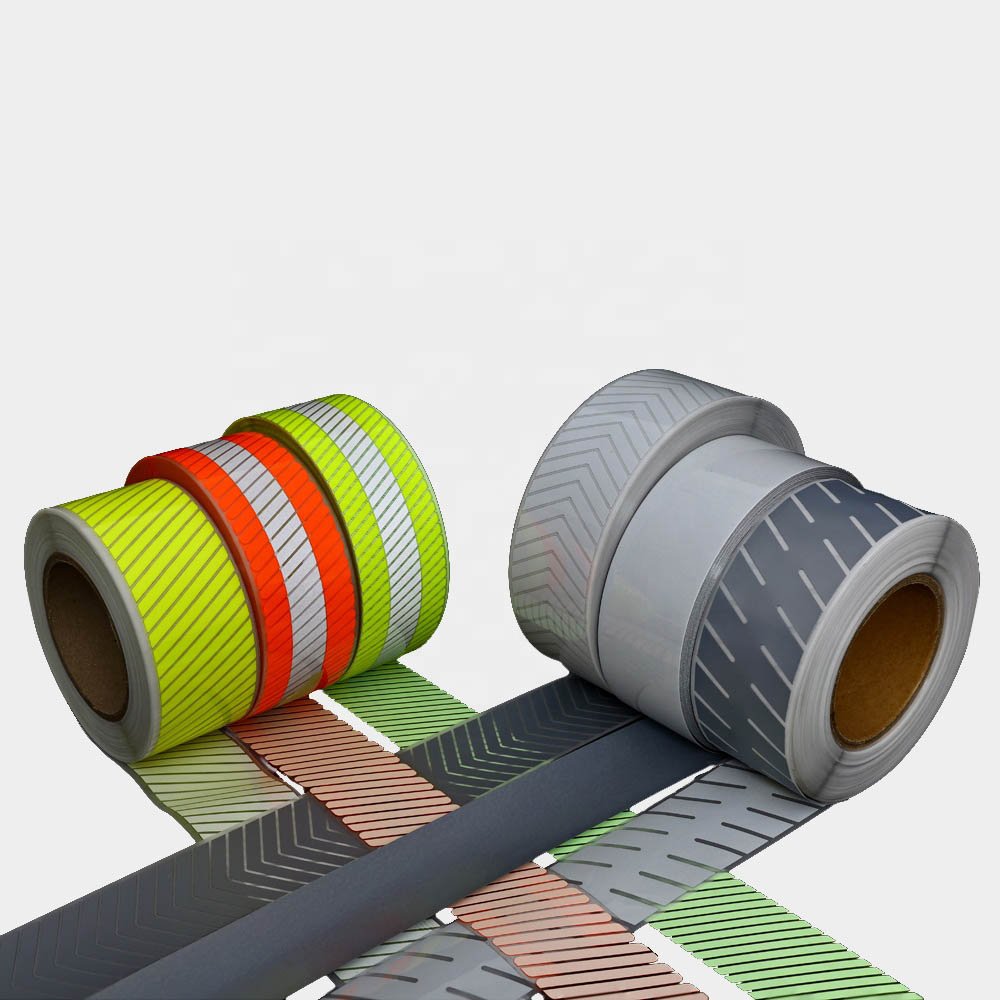
Segmented Reflective Films (Mid-Tier)
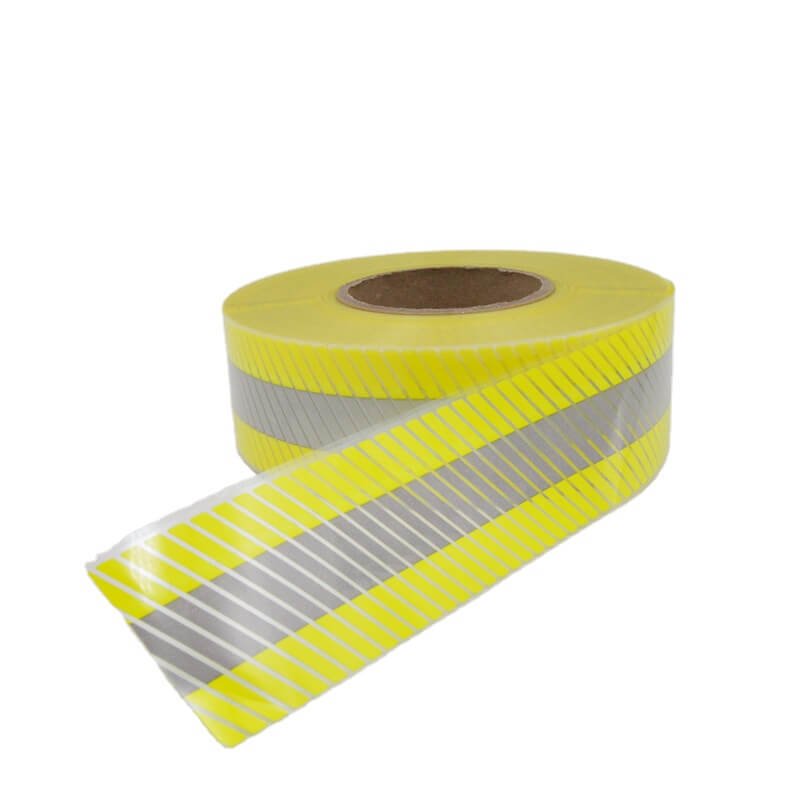
These use a perforated or segmented design that distributes stress more effectively. Initial RA values are typically 300-350 cd/lux/m², but durability is 2-3x superior to micro-prism films.
Compliance advantage: Segmented films maintain 80-90% of initial RA after 25-50 industrial washes. For garments intended for extended use, this substantially reduces replacement frequency and compliance risk. The trade-off? Slightly lower initial brightness and higher cost per meter.
Premium Glass-Bead Films (High-Performance Tier)
These use uniform glass beads embedded in a robust resin matrix. Initial RA can exceed 500 cd/lux/m². More importantly, wash durability often exceeds 75-80 washes before compliance degradation.
Compliance strength: Premium glass-bead films maintain their brightness under wet conditions and extreme UV exposure far better than alternatives. For safety-critical applications (railway, mining, emergency services), this tier is increasingly the regulatory preference.
Want to learn more about sourcing the right reflective film for your specific application? Explore our comprehensive reflective films catalog, where we detail performance specs, durability test results, and application recommendations for each tier.
Application Methods That Ensure Durability
Here’s the dirty secret of the industry: the same reflective film can pass or fail ANSI compliance depending entirely on how it’s applied. Application method is the bridge between material quality and real-world compliance.
Heat Transfer Application (Most Common)
This involves cutting the reflective film into pattern shapes and heat-bonding it onto the garment fabric using a heat press. Temperature, pressure, and dwell time are critical variables.
Compliance implications: Under-bonded films will delaminate during washing; over-bonded films can damage their optical properties. The best manufacturers use time-temperature profiles specific to each film type, verified through peel-strength testing (ASTM D6775).

Stitched Application (Industrial Durability Leader)
Reflective fabric strips are sewn directly onto the garment body. This is labor-intensive but provides unmatched compliance durability. Thread penetration creates mechanical anchors that resist wash degradation far more effectively than adhesive bonds alone.
Why factories avoid it: Stitching adds $0.50-$1.50 per garment compared to heat transfer. Yet for high-cycle industrial workwear, this up-front investment virtually eliminates mid-lifecycle compliance failures.
Hybrid Bonding (Best Practice)
Leading manufacturers combine heat-transfer bonding with edge-stitching for critical reflective stripe areas. This creates maximum adhesion (heat) plus mechanical reinforcement (stitching) where stress is highest.
Testing and Verification Protocols
Saying a garment “meets ANSI 107” is meaningless without specifying what testing preceded that claim. Here are the test protocols that actually matter:
Initial Retroreflective Performance (ASTM E810)
Measures RA and RV values right out of production. This is table-stakes testing; every compliant garment passes this. But it’s also the least meaningful, since it tells you nothing about what happens next.
Wash Durability Testing (ISO 6330 / AATCC 124)
The compliance reality-check. Garments are subjected to repeated industrial washing cycles (typically 25, 50, or 75 cycles) using standardized detergent and water temperature. Post-wash retroreflective performance is then re-measured.
What to demand: Test results showing RA values after 25, 50, and 75 wash cycles, not just initial values. Any supplier unable to provide this data is guessing about compliance.
Wet Condition Testing (EN ISO 20471 Supplement)
ANSI 107 itself doesn’t mandate wet-condition testing, but many professional environments (emergency services, highway maintenance) operate in rain and humidity. Testing reflective performance on wet fabric reveals whether your film choice is truly workplace-ready.
UV Accelerated Aging (ASTM G154)
Simulates 1-2 years of outdoor UV exposure in 5-7 days. Tells you whether that bright orange will fade to dull brown after a summer season. Budget films often lose 30-40% brightness; premium films maintain 90%+.
Long-Term Compliance: Maintenance and Replacement Cycles
ANSI 107 compliance isn’t a permanent state; it’s a trajectory. Every wash cycle moves your garment slightly further from the compliance threshold. Strategic maintenance planning separates responsible safety managers from those playing compliance roulette.
Establishing Replacement Cycles
Work backward from wash data. If your selected reflective film maintains 90% RA after 50 cycles and 85% after 75 cycles, and Class 1 compliance requires RA ≥ 200, then calculate your safety margin:
- If initial RA = 300, then post-75-wash RA = 255 (300 × 0.85). You maintain a 55-unit safety buffer above the 200 threshold.
- If initial RA = 220 (budget film), then post-75-wash RA = 187. You’re now below compliance.
Practical guidance: For garments using premium films and encountering 2-3 washes per week, set replacement cycles at 18-24 months. For budget films, plan 6-12 months. For high-volume-wash environments (commercial laundry services), quarterly testing and replacement may be necessary.
Compliance Documentation
Create an audit trail linking each garment batch to its reflective film specification, application date, and estimated replacement date. This documentation is your shield if regulators or litigants question whether you maintained ANSI compliance.
On-Site Brightness Testing
Investment in a portable retroreflectometer (typically $3,000-$8,000) allows quarterly compliance verification without sending garments to a lab. Track real performance over time, identify outliers (poorly bonded batches), and make data-driven replacement decisions.
Common Mistakes Manufacturers Make
After 15 years in this industry, I’ve watched manufacturers fail ANSI compliance due to preventable oversights:
❌ Mistake 1: Confusing Initial RA with Compliant RA
Buying films with RA = 220 (barely above Class 1 minimum) puts zero margin for degradation. After 20 washes, you’re below threshold. Always specify films with RA = 300+ minimum for premium-tier products.
❌ Mistake 2: Skipping Wash Testing Before Production
Running a single sample through 25 ISO cycles before committing to 10,000 units saves millions in recalls. I’ve seen major brands discover post-production that their film choice degraded faster than expected.
❌ Mistake 3: Mismatching Film to Fabric
Heat-transfer bonding works poorly on certain synthetic fabrics that have low adhesion properties. Test bonding strength (ASTM D6775 peel tests) on your actual garment fabrics, not generic test materials.
❌ Mistake 4: Outsourcing Without Compliance-Specific Contracts
If you’re outsourcing garment production, your contracts must specify ANSI 107 compliance criteria and test protocols. Vague contracts lead to suppliers cutting corners and passing compliance burden entirely to you.
❌ Mistake 5: Ignoring Wet-Condition Performance
Your workers don’t operate only in dry conditions. Films that maintain brightness when wet are essential for outdoor industries. Test this explicitly; it’s not covered by standard ANSI 107 protocols.
Frequently Asked Questions
Q: Can reflective films be removed and reapplied without losing compliance?
No. Heat-transfer films permanently bond during application; removal typically destroys both the film and can damage the fabric underneath. Stitched reflective materials can theoretically be replaced, but the effort and labor cost make this impractical for most operations. Plan for garment replacement, not film replacement.
Q: How does ANSI/ISEA 107 compare to EN ISO 20471?
Both standards define minimum retroreflective performance, but EN ISO 20471 is more prescriptive (specifying exact stripe placement and coverage areas), while ANSI 107 is performance-based. EN ISO typically requires slightly higher initial RA values. For North American operations, ANSI 107 is the legal requirement; for European markets, EN ISO 20471 is mandatory. Many manufacturers target both standards simultaneously for global distribution.
Q: What should I do if my batch fails compliance testing mid-lifecycle?
First, quarantine affected garments immediately—don’t let them enter the field. Second, conduct root-cause analysis: Was the film selection inadequate, or was application methodology at fault? If it’s a film issue, explore switching to premium tier with better wash durability. If it’s application, invest in better heat-press calibration or consider hybrid bonding. Finally, document the lesson and update your compliance protocols to prevent recurrence.
Q: Can reflective films meet Class 3 compliance out of the box and still fail after washing?
Absolutely. Class 3 requires higher initial RA (≥500 cd/lux/m²), but if a film degrades 40% after 25 washes, it drops to RA ≈ 300, compatible only with Class 1. This is why premium films with strong wash durability are essential for Class 3 applications—they need to maintain Class 2-equivalent performance after repeated cycling.
Q: Are there ANSI 107 Class 4 or higher standards?
ANSI 107 defines only Classes 1, 2, and 3. Class 3 is the highest and requires the most stringent performance criteria. Beyond this, specialized applications like Law Enforcement and Emergency Services often reference ANSI 107 but add proprietary requirements for light intensity or pattern configuration. Always check with your industry-specific regulatory body for enhanced requirements.
Q: How often should I test my garment batches for ANSI compliance?
Best practice: Test initial and post-wash performance (25 and 50 cycles) on samples from each production batch. Then implement field testing (retroreflectometer measurements) quarterly or semi-annually depending on wash frequency and intended garment lifespan. This creates a data trail proving compliance responsibility to regulators and courts.
Q: What’s the difference between segmented and micro-prism reflective films?
Micro-prism films use tiny glass prisms for light refraction (cheaper, higher initial brightness, poor wash durability). Segmented films have perforated or patterned designs that distribute mechanical stress more effectively during washing (more expensive, lower initial brightness, superior durability). Segmented films are best for high-cycle environments; micro-prism films for low-cycle applications where cost is paramount.
🎯 Key Takeaways: Your ANSI 107 Compliance Checklist
- ✓ Prioritize wash durability over initial RA: Demand test data showing retroreflective performance after 25, 50, and 75 ISO wash cycles.
- ✓ Match film type to application: Budget micro-prism for disposable/short-cycle use; segmented films for industrial workwear; premium glass-bead for safety-critical environments.
- ✓ Verify application methodology: Request peel-strength test results; ensure bonding reliability through heat-transfer or hybrid bonding protocols.
- ✓ Build compliance margin: Never buy films with initial RA barely above the Class requirement; use 300+ RA minimums to protect against predictable degradation.
- ✓ Plan replacement cycles: Calculate expected RA retention and establish data-driven garment replacement schedules, not arbitrary guesses.
- ✓ Document everything: Create an audit trail linking batch numbers to film specifications, test results, and replacement dates for regulatory defensibility.
Ready to Source ANSI 107-Compliant Reflective Films?
VizGlo Safety specializes in high-performance reflective materials with documented wash durability. Our films maintain 90%+ RA retention after 75 ISO cycles—industry-leading performance. Get a no-obligation consultation on your specific application.
Schedule Your Compliance ConsultationDeepen Your Knowledge: Reflective Film Fundamentals
This article focused specifically on ANSI 107 compliance strategies, but reflective materials encompass a broader ecosystem of standards, applications, and material innovations. To build a comprehensive understanding of reflective technology—from basic principles through advanced color-shifting films and specialty applications—visit our complete Reflective Films Resource Center.
There you’ll find detailed product specifications, comparative performance data, industry case studies, and guidance on selecting the optimal reflective solution for your unique market segment.
Have a specific ANSI 107 compliance challenge? Share your application details—garment type, expected wash frequency, performance classes required—and our team will provide a customized film recommendation with supporting durability data.
Get Your Compliance RecommendationReferences & External Resources
- ISEA (International Safety Equipment Association) – Official ANSI 107 Standards Authority
- ASTM E810 Test Methods for Retroreflective Materials
- ISO 6330:2012 Textiles – Domestic washing and drying procedures for textile testing
- AATCC (American Association of Textile Chemists and Colorists) – Textile Testing Standards
- OSHA Workplace Safety & Health Standards for High-Visibility Attire
- 3M Reflective Materials Research & Development History
- High-Visibility Clothing Standards Overview (Global Perspective)